Introduction
For decades, designers and creative professionals accepted late nights, endless revisions, creative blocks, and tight deadlines as part of the job. Whether you were a graphic designer, UI/UX designer, illustrator, photographer, video editor, motion designer, or frontend developer, productivity was largely limited by the number of hours you could physically work.
Artificial Intelligence has fundamentally changed that equation.
Today’s AI is no longer just about generating images from prompts. It has become a creative assistant capable of brainstorming ideas, writing copy, generating layouts, editing images, creating prototypes, writing code, organizing files, automating repetitive work, and even collaborating alongside designers.
Rather than replacing creativity, AI is allowing creatives to spend less time on repetitive production tasks and more time on strategy, storytelling, innovation, and human-centered design.
The Old Creative Workflow
A typical design project before AI often looked like this:
- Client briefing
- Research
- Moodboards
- Sketches
- Wireframes
- Design exploration
- Asset creation
- Icon searching
- Image editing
- Content writing
- Revisions
- Development handoff
- Documentation
Many of these stages required manual work, resulting in 10–16 hour workdays, especially for freelancers managing multiple clients.
Creative burnout became common across the industry.
AI Isn't Replacing Designers
One of the biggest misconceptions is that AI replaces designers.
It doesn’t.
AI replaces repetitive work.
Designers solve problems.
AI helps execute ideas faster.
Human creativity still drives:
- Brand strategy
- User psychology
- Storytelling
- Emotional design
- Visual hierarchy
- Customer experience
- Design systems
- Business thinking
AI simply removes much of the mechanical work between the idea and the final result.
Industry leaders increasingly emphasize that design quality, taste, empathy, and understanding user needs remain the differentiators, even as AI accelerates production.
Brainstorming Ideas
Instead of staring at a blank canvas, designers can ask AI to generate:
- Color palette ideas
- Brand concepts
- Logo directions
- Landing page structures
- Marketing campaign ideas
- Typography pairings
- UX improvements
- Moodboards
What once took several hours can often be reduced to minutes.
Faster Content Creation
Designers frequently wait for clients to provide:
- Headlines
- Product descriptions
- Social captions
- Blog articles
- Email copy
- CTAs
AI can generate first drafts instantly, allowing designers to focus on layout and visual communication rather than waiting on content.
Wireframes and UI Design
Modern AI-powered design tools can generate:
- Login pages
- Dashboard layouts
- Landing pages
- Mobile app screens
- User flows
- Components
Instead of starting from scratch, designers refine AI-generated concepts.
Recent advancements in collaborative design platforms show AI generating layouts, editing existing designs, automating repetitive tasks, and supporting cross-functional workflows.
Image Generation
Tools like Adobe Firefly, Midjourney, Flux, and ChatGPT image generation allow creatives to produce:
- Product mockups
- Concept art
- Marketing visuals
- Social media graphics
- Background scenes
- Character concepts
Stock image searches that once took hours can often be replaced by custom visuals generated in minutes.
Faster Prototyping
Product designers can rapidly generate:
- User flows
- Interactive prototypes
- Wireframes
- UI components
Instead of spending days creating initial concepts, AI enables teams to validate ideas much earlier in the design process.
Industry research also indicates that AI is changing collaboration itself, with more designers participating in development and more developers contributing to design workflows.
AI Reduces Creative Burnout
Before AI:
- Long nights
- Repetitive edits
- Endless asset searching
- Constant deadline pressure
Today:
- Faster iterations
- Better work-life balance
- More creative exploration
- Reduced repetitive labor
AI doesn’t eliminate deadlines, but it reduces the time spent on low-value tasks.
Challenges Designers Should Keep in Mind
AI is powerful, but it has limitations.
Creative professionals should avoid:
- Over-relying on generic outputs
- Ignoring copyright and licensing considerations
- Losing a unique visual identity
- Publishing AI-generated work without review
- Skipping accessibility or usability testing
The best results still come from human judgment combined with AI assistance.
Challenges Designers Should Keep in Mind
The future belongs to designers who know how to collaborate with AI.
Tomorrow’s most valuable creative professionals won’t necessarily be those who can work the longest hours, they’ll be those who can:
- Ask better questions
- Write better prompts
- Understand users deeply
- Combine creativity with technology
- Think strategically
- Deliver results faster without sacrificing quality
AI is becoming an everyday collaborator across design, development, and marketing rather than a standalone novelty.
Final Thoughts
Artificial Intelligence has changed the creative industry more in the last few years than many previous decades of software evolution combined.
The goal is not to replace designers but to eliminate repetitive work, reduce burnout, accelerate experimentation, and give creatives more time for meaningful problem-solving.
The designers who embrace AI responsibly will likely deliver higher-quality work, respond to clients faster, explore more ideas, and maintain healthier work-life balance than those who rely solely on traditional workflows.
The future of design isn’t Human vs AI.
It’s Human + AI.
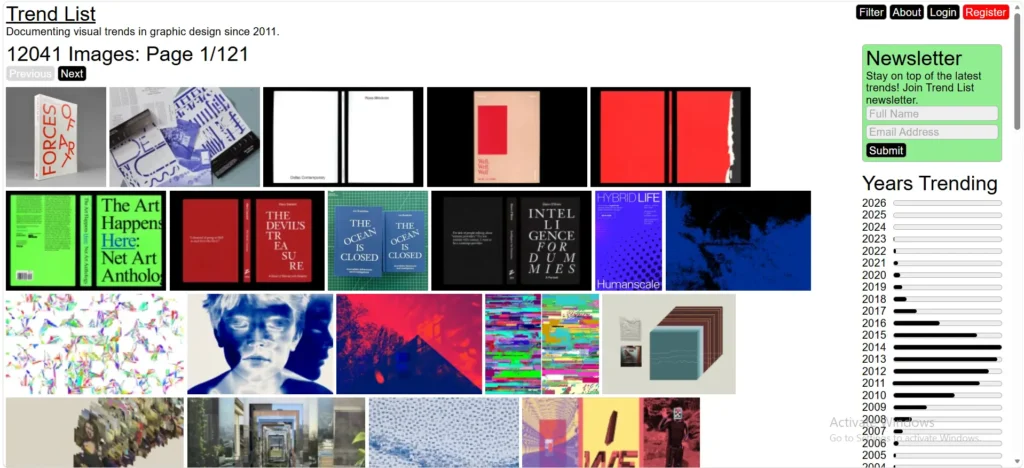
You begin noticing patterns:
- Brutalist typography
- Minimal grids
- Experimental layouts
- Swiss-inspired systems
- Distorted type treatments
- Neo-futuristic visuals
- Editorial asymmetry
Every generation unknowingly speaks through visual patterns.
The site encourages designers to look beyond originality myths and understand how culture influences aesthetics. Once you understand trends historically, you stop copying visuals blindly and start using them intentionally.
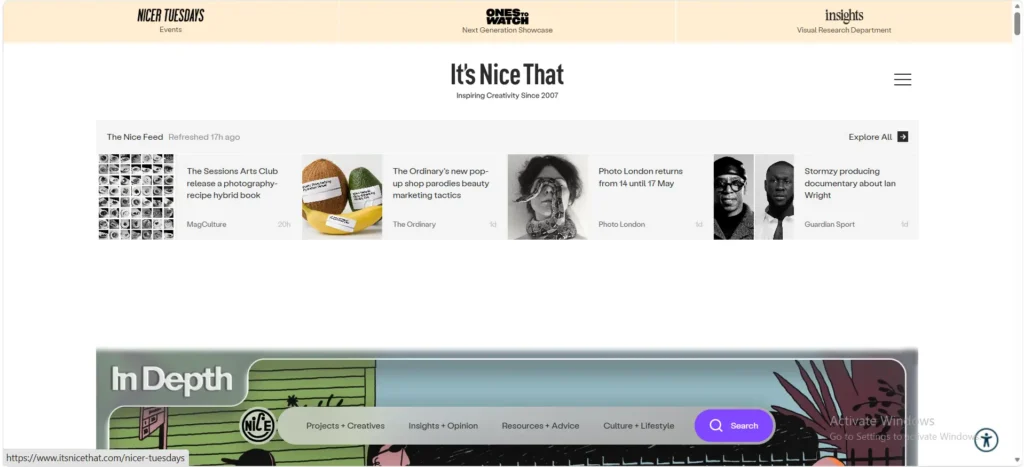
It’s Nice That exists to inspire the global creative community by showcasing diverse talent, original projects, and industry insights. Founded in 2007, the platform grew from a university brief into one of the most influential creative publications online.
Unlike traditional design galleries, this platform feels human.
It explores:
- The stories behind creative work
- Artistic processes
- Emerging designers
- Creative struggles
- Visual culture
- Experimental thinking
Scrolling through It’s Nice That feels like walking through a modern creative museum where graphic design, illustration, photography, animation, fashion, branding, and motion graphics all coexist naturally.
The beauty of the platform is its emotional intelligence. It reminds creatives that design is not only about aesthetics — it’s about ideas, communication, personality, and perspective.
This site is especially valuable for creatives who feel trapped inside algorithm-driven inspiration platforms. Instead of endless polished perfection, you discover experimentation, personality, and individuality.
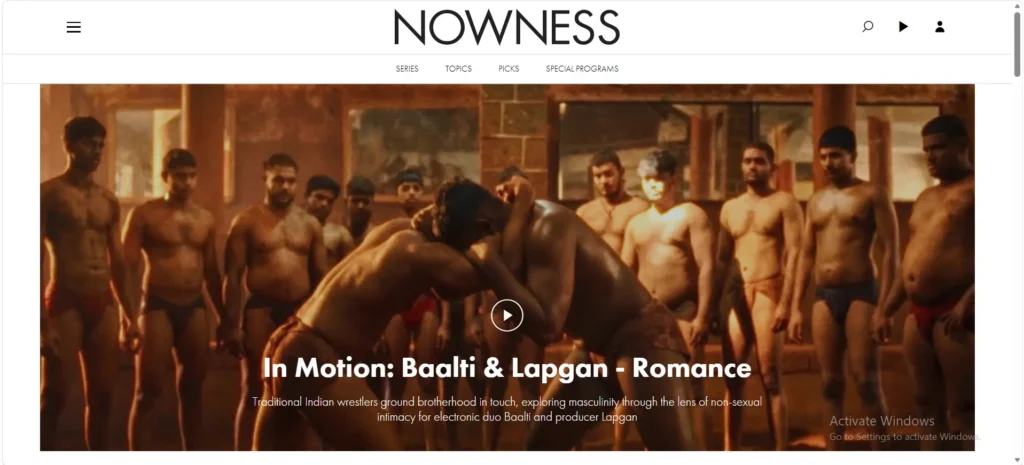
NOWNESS is where cinema, art direction, emotion, fashion, and storytelling collide.
This platform is less about static visuals and more about atmosphere.
Every film, visual story, or editorial piece on NOWNESS feels intentionally crafted — from sound design and pacing to framing and mood. It pushes creatives to think beyond composition and consider:
- Movement
- Emotion
- Silence
- Rhythm
- Texture
- Human connection
NOWNESS helps creatives understand that visual communication is not always loud. Sometimes the strongest creative work is subtle, cinematic, and emotionally immersive.
If Trend List sharpens your eye for design systems, NOWNESS sharpens your sense of mood.
It’s particularly powerful for:
- Filmmakers
- Motion designers
- Fashion creatives
- Brand storytellers
- Luxury visual designers
- Creative directors
The platform encourages slower observation — something modern creative culture desperately needs.
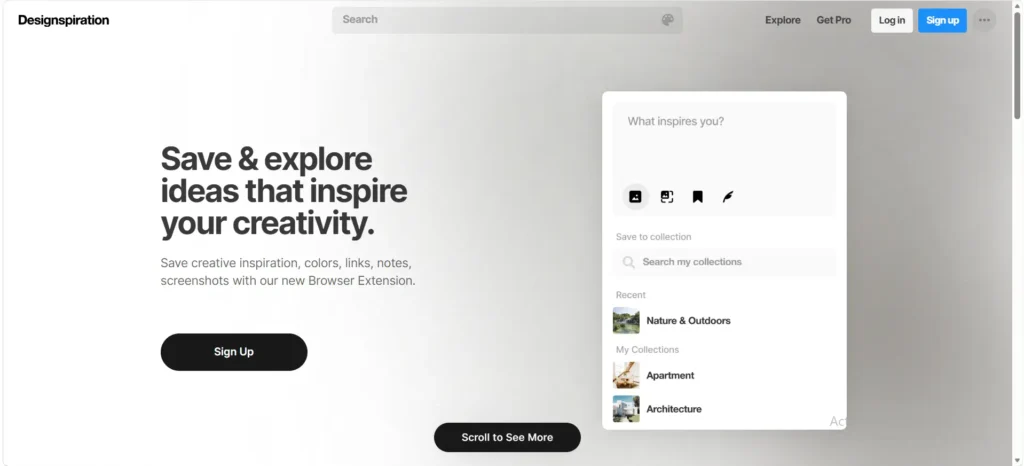
Designspiration is a curated inspiration platform created to help creatives collect, organize, and explore visual ideas. The platform focuses heavily on discovery and creative exploration through searchable imagery and collections.
Think of it as a visual playground for your subconscious mind.
You can explore:
- UI inspiration
- Branding systems
- Color palettes
- Typography
- Packaging
- Architecture
- Product photography
- Fashion aesthetics
The real value of Designspiration comes from association. When you repeatedly expose yourself to diverse visual combinations, your brain starts forming unexpected creative connections.
This is how original ideas often emerge:
- not from a single reference —
- but from combining multiple unrelated inspirations into something new.
Designspiration also encourages visual curation skills. Learning what to save, organize, and revisit is part of becoming a better creative thinker.
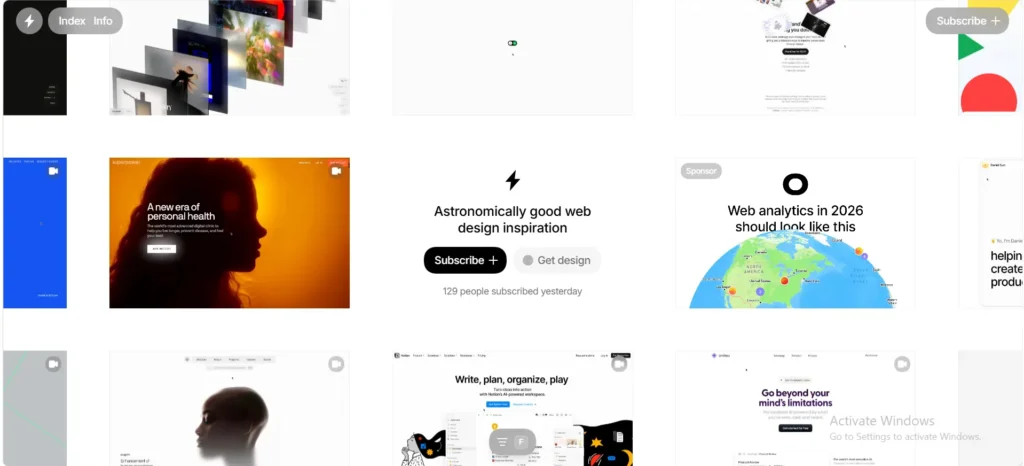
Godly is a curated platform focused on showcasing exceptional web and interactive design. Founded in 2021, the site highlights carefully selected high-quality websites with strong emphasis on creativity, interaction, motion, and user experience.
This platform is essential for modern web designers because today’s websites are no longer just layouts — they are experiences.
Godly showcases:
- Interactive storytelling
- Smooth motion systems
- Experimental navigation
- Creative scrolling experiences
- Modern portfolio design
- Premium product presentation
- Advanced UI transitions
Browsing Godly changes the way you think about websites entirely.
You stop asking:
How should this website look?
And start asking:
How should this website feel?
For designers working in web development, branding, motion design, or creative portfolios, Godly becomes a source of next-generation thinking.
Why These Platforms Matter
A designer who only studies design trends eventually becomes repetitive.
But a designer who studies:
- Film,
- Interaction,
- Storytelling,
- Typography,
- Motion,
- Photography,
- Culture,
- and Human emotion…
develops a visual language that feels alive.
Creative growth happens when you intentionally expose yourself to different forms of thinking.
One Reddit designer explained that inspiration should not simply be “copying beautiful things,” but researching references that solve creative problems intelligently. Another creative pointed out that looking outside your own discipline helps prevent accidental imitation and keeps ideas fresh.
That is exactly what these platforms help you do.
Conclusion
The internet is full of inspiration, but not all inspiration expands your vision.
Some platforms feed trends. Others train perception.
Websites like Trend List, It’s Nice That, NOWNESS, Designspiration, and Godly.website help creatives move beyond surface-level aesthetics and into deeper visual understanding.
The more diverse your visual intake becomes, the broader your creative vision grows.
Study these platforms carefully. Observe patterns. Analyze moods. Save references. Understand why something works emotionally, visually, or conceptually.
Because great ideas rarely appear suddenly.
They evolve from everything your eyes have learned to notice.
Nvidia and Corning Expand AI Infrastructure Manufacturing
Executives from both companies highlighted the growing importance of optical networking as AI systems become larger and more power-intensive. Corning plans to expand production capabilities substantially while creating thousands of new jobs tied to advanced manufacturing and AI infrastructure development.
Industry analysts view the partnership as part of Nvidia’s broader strategy to secure critical supply chains beyond semiconductors. As demand for AI computing accelerates worldwide, companies are increasingly investing in supporting technologies such as fiber optics, cooling systems, and data transfer infrastructure.
The announcement also reflects a wider movement toward strengthening U.S.-based technology manufacturing, especially in sectors connected to artificial intelligence and next-generation computing networks.
The tech world never stands still. Every year brings new gadgets that redefine how we live and work.
What’s Trending Right Now
- Apple Vision Pro — blending digital and physical worlds
- Samsung Galaxy Z Fold — pushing smartphone design forward
- Meta Quest 3 — making virtual reality more accessible
Smart Living Is Expanding
From smart homes to wearable tech, devices are becoming more integrated into daily life.
Innovation vs Practicality
While new gadgets are exciting, users are now focusing more on real-world usability rather than just features.
Conclusion
Technology isn’t just evolving — it’s becoming more personal, intuitive, and immersive.
We often hear that AI improves quality — better designs, cleaner code, smarter decisions. But the real transformation lies somewhere else: time.
Speed Meets Precision
Tools like ChatGPT and Midjourney allow creators to go from idea to execution in minutes instead of hours.
Time Management Revolution
AI eliminates repetitive tasks — writing drafts, generating layouts, analyzing data — freeing up time for deeper thinking and creativity.
Quick Results, Better Decisions
Faster output doesn’t mean lower quality. In fact, quick iterations allow professionals to test, refine, and improve ideas rapidly.
The Human-AI Balance
AI doesn’t replace humans — it enhances them. The best results come from combining human creativity with machine efficiency.
Conclusion
AI’s biggest impact isn’t just what it creates — it’s how much time it gives back.